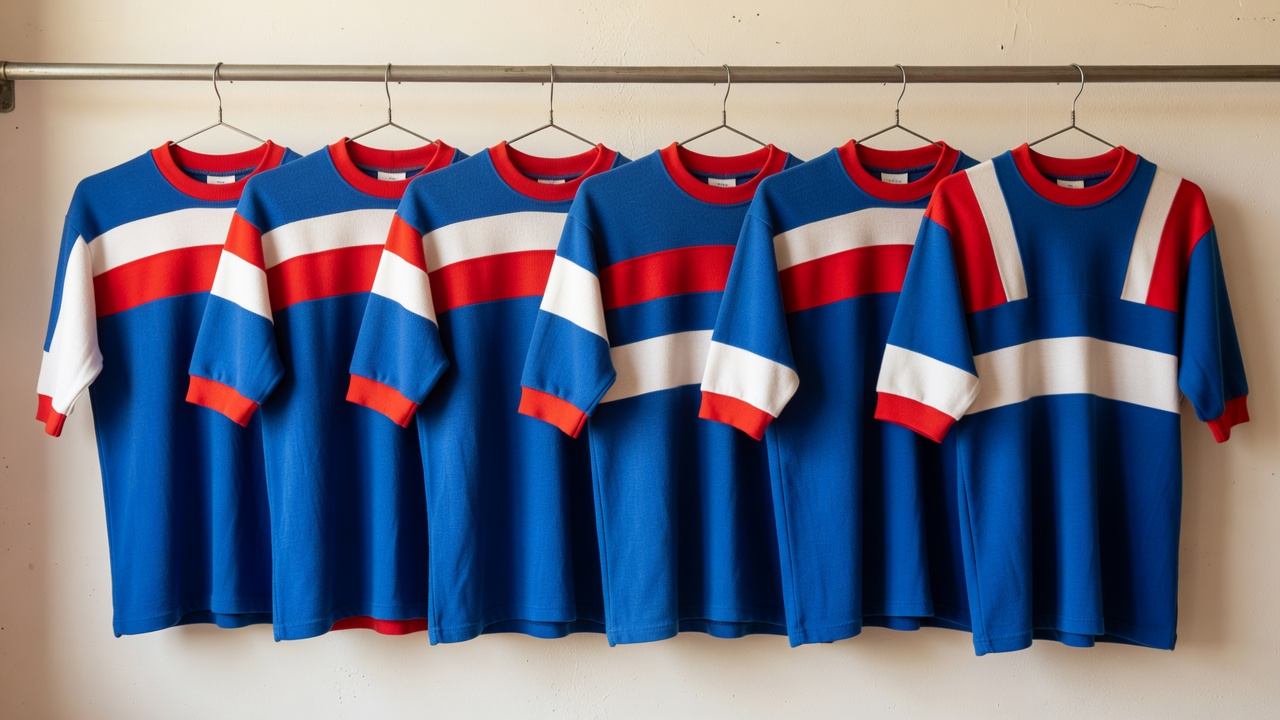
In international cricket, few color associations are as globally dominant as the phrase "Men in Blue." Yet for the first century of organized cricket in India, players wore only pristine white flannel. The entry of color into the Indian sporting consciousness was not a spontaneous aesthetic revolution; it was born out of Kerry Packer’s World Series Cricket in Australia and crystallized during the monumental 1985 Benson & Hedges World Championship of Cricket down under, where India took the field in sky-blue and canary-yellow trims.
Across four decades, this jersey evolved from heavy cotton blend shirts with oversized collars into ultra-engineered, moisture-wicking aerodynamic masterpieces.
1. The 1992 World Cup: The Oxford Blue Masterpiece
Considered by fashion historians and sportswear collectors to be the greatest cricket kit template ever conceived, the 1992 Benson & Hedges World Cup unified every participating nation under a standardized color-block template. India was assigned a rich Oxford indigo blue featuring bold shoulder chevron stripes containing rainbow hues.
Worn by an 18-year-old Sachin Tendulkar scoring his first World Cup half-centuries in Australia, the shirt broke free from colonial white. It was vibrant, modern, and instantly collectible. The 1992 kit remains the highest-selling retro merchandise replica in Indian sports retail.
2. The 1996 World Cup: The Pastel Yellow & Turquoise Pivot
When the tournament returned to the subcontinent in 1996, the kit took a dramatic departure into sunny pastel tones. Dominated by pale turquoise blue with a broad chest band of bright sunburst yellow and stylized arrow motifs across the collar, it captured the optimism of mid-90s consumerism. Every kid playing in alleys across Mumbai, Lahore, and Colombo wore counterfeit editions of this loose-fitting cotton shirt.
3. The 2003 World Cup: Aggressive Contrast and Saurav's Tigers
The 2003 edition in South Africa saw India adopt a darker, steelier aesthetic designed to mirror the fearless ethos of Sourav Ganguly’s young squad. The jersey featured electric blue accented by bold matte-black side flanks and the national tri-color brushstroke slashed diagonally across the torso. Paired with yellow numbers, this jersey became synonymous with Sachin’s iconic upper-cut six off Shoaib Akhtar in Centurion.
"A jersey in India is not mere athletic apparel. It is armor. When a player pulls that shade of blue over their head, they are carrying the dreams, insecurities, and collective prayers of a billion people on their chest."
Technical & Design Evolution Matrix
| Kit Era | Dominant Color Shade | Material Composition | Key Design Signature |
|---|---|---|---|
| 1992 World Cup | Oxford Indigo Blue | Heavy combed cotton-poly blend | Rainbow chevron shoulder stripes; wide v-neck polo collar. |
| 1996 Wills Trophy | Turquoise Blue & Canary Yellow | Textured woven polyester | Geometric arrow accents across chest and sleeve ribbing. |
| 1999 World Cup | Sky Blue / Cerulean | Lightweight pique polyester | Iconic yellow diagonal geometric wing pattern extending from collar to waist. |
| 2003 World Cup | Cobalt Blue & Charcoal Black | Double-knit moisture control poly | Tri-color diagonal spray brushstrokes with bold black underarm side inserts. |
| 2011 World Cup | Deep Royal / Ultramarine Blue | Recycled bottle micro-mesh fabric | Saffron player lettering; laser-cut ergonomic side ventilation panels. |
Fabric Engineering: From Cotton Soak to Recycled Aerodynamics
The functional performance of these jerseys has undergone an astonishing technological leap:
- Thermal Regulation: In the 1980s, heavy cotton uniforms soaked up perspiration in humid subcontinental venues like Chennai, adding up to 800 grams of water weight during an afternoon fielding stint.
- Ecological Construction: Since 2011, elite player kits are manufactured from yarn extruded from 33 recycled PET plastic bottles, cutting carbon footprint and maximizing multi-directional stretch.
- Anti-Chafing Flatlock Seams: Modern kits utilize ultrasonic bonding and flat seams that eliminate skin friction during sliding dives on abrasive subcontinental outfields.