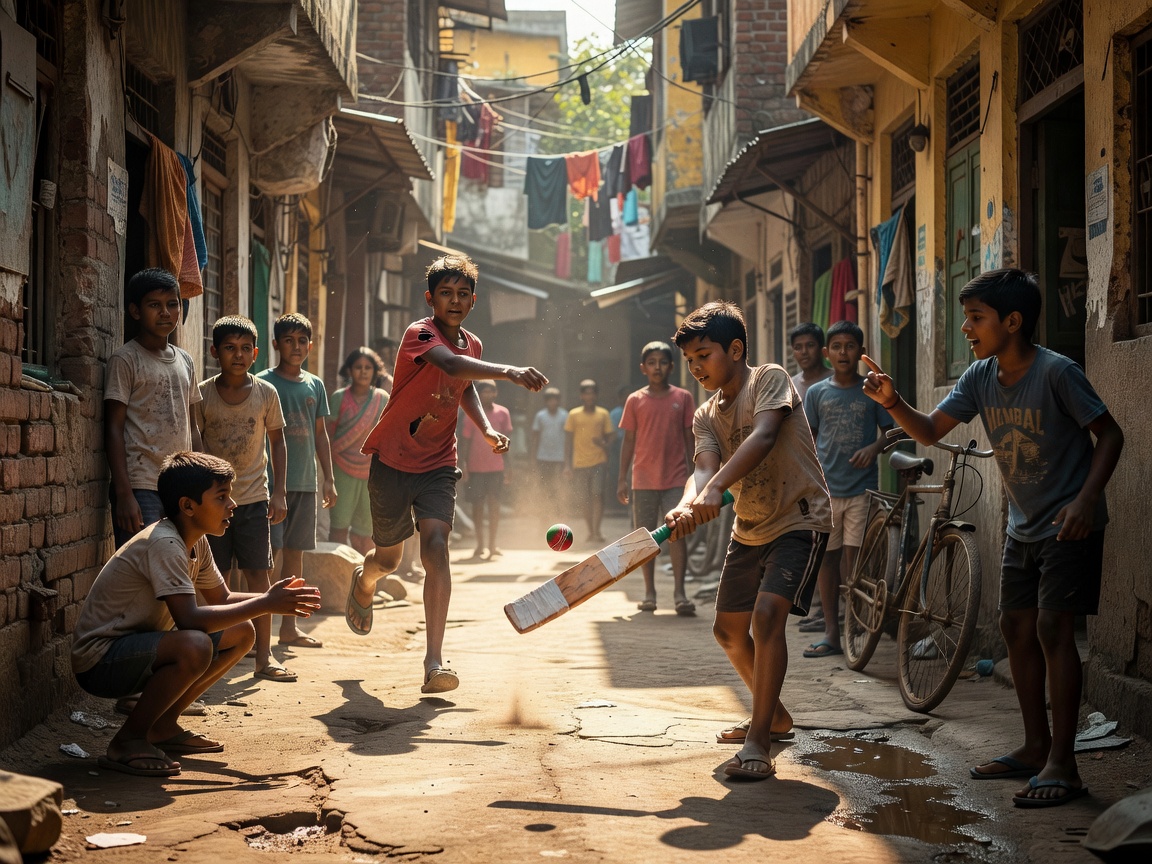
The Marylebone Cricket Club (MCC) in London may possess the official copyright over the Laws of Cricket, but across the alleys of Old Delhi, the narrow chawls of Mumbai, and the residential lanes of Kolkata, their 42 laws are deemed completely insufficient. Gully cricket is an art born out of physical constraints: narrow boundaries, parked scooters, fragile glass panes, and an endless shortage of tennis balls.
Out of this urban density emerged a sophisticated, unwritten legal doctrine that every Indian child learns before they master long division.
The Fundamental Canon of Street Cricket
1. The Bat-Owner's Sovereign Immunity
The universal, unshakeable cornerstone of all street matches: whoever brings the wooden bat owns supreme executive privilege. They bat first. They bowl the premier over. Should an unfavorable dismissal occur in the first three deliveries, they possess the discretionary authority to claim a "trial ball." And most crucially: if the bat-owner storms off home in anger, the game ceases to exist.
2. One-Tip, One-Hand (With Wall Regulations)
Because alleys rarely accommodate slip cordons and deep mid-wicket sweepers, any delivery that bounces once may be caught cleanly with a single hand to constitute an out. However, if the catcher touches the boundary wall, parked Maruti 800, or electrical meter box while executing the catch with their other hand, the dismissal is rendered null and void.
3. Direct Glass Hit: Out and Fined
Hitting a towering six into the street is not celebrated with fireworks—it is greeted by widespread terror. If a batsman clears the building line directly and shatters an auntie’s balcony windowpane, two immediate legal sanctions follow: the batter is instantly declared OUT, and they alone are mandated to climb the staircase, face the irate homeowner, and retrieve the ball.
"Gully cricket taught me how to hit the ball along the ground with supreme wrists. If you lofted the ball into Mrs. Sharma's garden, your match was finished and your ball was impounded forever."
The Street Ball Evolution: Heavy Tennis vs. Taped Tennis
| Ball Type | Preparation Method | Behavior & Dynamics | Street Durability |
|---|---|---|---|
| Standard Green Felt Tennis (Cosco/Nivia) | Used straight from the pressurized tin canister. | Extreme sponge bounce; difficult to drive; highly vulnerable to asphalt friction cuts. | Approx. 12 to 18 overs on rough tarmac. |
| Electrical Tape-Ball (Subcontinental Mod) | One hemisphere wrapped tightly with PVC insulation tape. | Simulates genuine 145 kph reverse swing; wicked lateral dip; low skidding trajectory. | 20+ overs; tape can be reapplied at innings break. |
| Heavy Hard-Tennis (Red/Maroon) | Dense compressed core, weight ~125g, rubberized surface. | True carry, mimics cork ball without requiring expensive protective pads and helmet. | High; lasts multiple weekend tournaments. |
Specialty Gully Roles and Specialized Positions
- The Common Man (Kacha Nimbu): When an odd number of players show up, the youngest kid is appointed the neutral player. They bat for both teams, bowl an obligatory two overs of slow underarm, but are strictly prohibited from scoring real boundaries.
- The Baby Over: If the setting sun begins dipping behind the water tanks or street lamps begin flickering to life, team captains mutually agree to truncate the final over to three deliveries to finish the chase before nightfall.
- The Electric-Pole Wicket: In the absence of wooden stumps, three chalk lines drawn onto a lamppost or a rusted kerosene tin serve as the target. Any strike that produces a distinct metallic chime is undisputed proof of bowled.
Why Gully Cricket Forged Modern Indian Champions
The demanding environment of alleyway play is precisely why Indian batsmen possess world-renowned wrist dexterity. When you cannot hit the ball in the air due to window penalties, you develop exquisite flick shots, late cuts, and shovel sweeps. Bowlers like Jasprit Bumrah honed their hyper-compact, short run-up yorkers because there was simply no runway available in the concrete courtyards of Ahmedabad.